
The Blinded Samson is a painting by Lovis Corinth. It represents a dramatic image of the biblical character: he rushes forward towards the viewer, after having been betrayed by his love and attacked by his enemies. The painting strikes with its impetuosity, depicting a character in all his strength and horror. Samson’s powerful arms, blood-streaked face, and mouth twisted with pain may be the painter’s reaction to his own fear and agony. Corinth created this piece a year after suffering from a stroke that threatened his life.
About the author
Born in 1858, Lovis Corinth was a German artist, painter, and printmaker. His work was mainly classified as a synthesis of expressionism and impressionism. He died in 1925 leaving behind a vast oeuvre that includes biblical scenes, nudes, self-portraits, and landscapes.
He studied in Paris and Munich and later joined the Berlin Secession group. Corinth became the president of this group eventually, succeeding the painter, Max Liebermann.
At first, he was resistant to the expressionist movement, but this changed after he had a near-death experience. In 1911, Corinth had a stroke, and this was reflected in his work. His art became more vital and powerful with more vibrant colors. These are qualities inherent to expressionism. The Blinded Samson was painted during this period.
Childhood and early career
Franz Heinrich Louis was born on the 21st of July 1858 in Tapiau, Prussia. He adopted the name Lovis Corinth in 1888 after returning from his first stay in Munich. Since he showed a remarkable talent from early childhood, he started to attend painting lessons at the Königsberg Academy. This city was located in the territory that we know today as the Kaliningrad Oblast. Nowadays, this is a province that belongs to the Russian Federation although exists as an enclave located in Europe.
At first, Corinth wanted to become a history painter but was dissuaded by his teacher, Otto Günther. When he was 22 years old, he went to Munich, which was one of the most important art centers in Europe at the time.
For a short period, he studied with Franz von Defregger but soon was admitted into the Academy of Fine Arts Munich. There he studied with Ludwig von Löfftz, who had a decisive influence on the young artist. Corinth’s early realistic style is due greatly to this instructor.
He studied under Löfftz for four years (with a short break due to military duty) and then moved to Paris. This was the second most important art hub of the late 19th century. He entered the Académie Julian where he studied with Tony Robert-Fleury and William-Adolphe Bouguereau. During his Paris period, Corinth was mainly focused on improving his drawing technique. He specialized in the female nude.
Career development
He came back to Königsberg in 1888 but returned to Munich in 1892 where he joined the Munich Secession. However, this was not his most productive period.
In 1900 he moved to Berlin where his professional activity became more dynamic. He had an exhibition at an art gallery whose owner was Paul Cassirer. Two years later he opened a painting school for women. He was 42 years old at the time. There he met the woman that would become his wife: Charlotte Berend. Charlotte was Lovin’s first student and was nearly 20 years younger than him. Anyway, she became his muse and spiritual partner, and they had two children.
Family life thus became one of Corinth’s central subjects. Some examples are Self Portrait with his Charlotte Berend and Champagne Glass (1902), Charlotte in a White Dress (1902), and The Artist and His Family (1909).
A stroke and a shift in style
In 1911, Corinth suffered a stroke from which he became partially paralyzed from the left side. His hands showed a tremor and walked with a limp. He was able to return to painting a year after the incident thanks to his wife’s influence.
The distress caused by the stroke influenced the artist’s state of mind. Hence, his work became more expressive using more vibrant colors. A style that was becoming particularly popular in the United States at the time. America casinos had many of these vibrant color pieces adorned on their walls. The casino boom, which over 100 years later, is still going on and has resulted in the creation and popularity of online casinos in the US today. He also showed special interest in daily-life activities of which his cycle of casual etchings constitutes proof. These depicted the family life in the countryside.
His landscapes are also from this period with mainly the Walchen lake in Germany as a setting. Corinth owned a house in the Bavarian Alpes, which served as a source of inspiration for the colorful paintings of this new period. This series is known as ‘the Walchensee series’ and is considered some of his best work.
He painted many self-portraits, especially on his birthdays. This was kind of a self-assessment for the author. He even put his face into known characters like an armored knight in The Victor (1910), and Samson on the painting that constitutes this article’s subject: The Blinded Samson (1912).
Some of his paintings from this period are:
- Portrait of Mrs. Kaumann (1911)
- Hangover Breakfast (1913)
- Flower Basket with Amaryllis, Lilac, Roses, and Tulips (1914)
- Flowers and Daughter Wilhelmine (1920)
- The Red Christ (1922)
- Susanna and the Elders (1923)
- Self-portrait with Palette (1924)
- Ecce Homo (1925)
Although not all his work was appreciated during his lifetime, he received some acknowledgment. From 1915 to 1925 he was president of the Berlin Secession and in 1921 was given an honorary doctorate from the University of Königsberg. He died in 1925 from pneumonia.
About The Blinded Samson
Painted in 1912, The Blinded Samson is considered an autobiographical piece. Besides representing Samson with his own face, Corinth depicts his suffering through the biblical character. When he had the stroke, the artist was a renowned figure in the local art scene. His work was widely exhibited, he had a painting school and had published several essays. But this incident altered his life and ability to work. It doesn’t come as a surprise that Corinth would represent this agony when he was able to paint again, after a year of recovery. This can be seen in many of his works. The Blinded Samson was his first large painting after the stroke and showed a significant change of style. Around the same time, he painted a piece on Job and his friends, also highly autobiographical. The resemblance between The Blinded Samson and Ecce Homo (1925) is remarkable. Painted several years later (in the year of his death), this large oil canvas is as impressive as this article’s subject. The viewer is struck by the blood dripping from the crown of thorns, in the same way, it drops from Samson’s mutilated eyes. The manacled figure, the spiritual and physical agony conveyed by the man’s facial expression are nothing compared to the tortured body, suffering from pain and indignity. It’s only natural to interpret these as signs of what the author was feeling, being partially paralyzed and crippled.
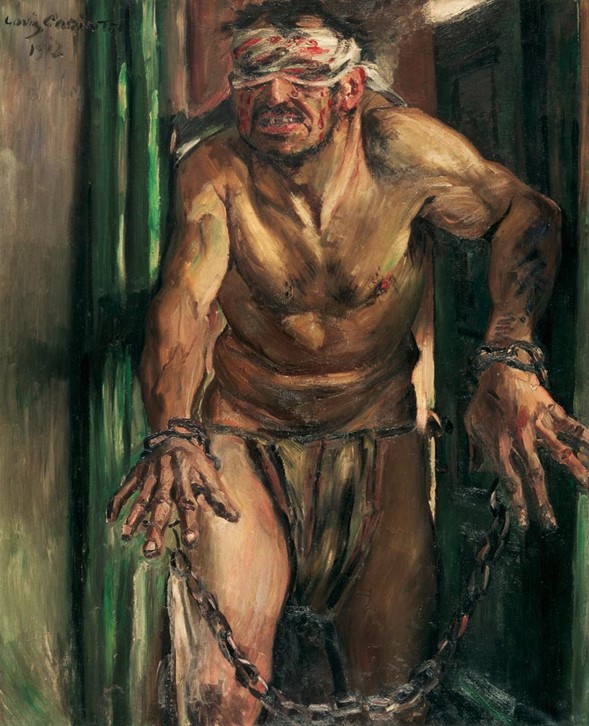 The Blinded Samson (1912) Source: https://www.wga.hu/html_m/c/corinth/corint09.html
Samson: Tragedy or comedy?
Samson has been seen on multiple occasions as a tragic hero. Especially in art or biblical criticism. Under a more thorough analysis, the witty, libidinous, and destructive character shows many contradictions similar to the popular trickster figure.
The story ends with Samson’s reconciliation with God, who gives him back his powers so he can defeat the enemies of Israel. This is a religious vision that we can see in action even in our days: all is justified for the sake of faith. That is, in this case, the suffering of Samson and the death of 1,000 Philistines by his hand, which is tolerated because the life of the Israelite people goes on.
Yet, some revisions also put this character under the ‘comic’ or ‘tragicomic’ categories. What does Samson lack that doesn’t allow him to achieve truly tragic status? We can find the answers in his character.
The repeated skirmishes with the Philistines and reiterated weakness for women make Samson’s story closer to comedy than tragedy. This is enhanced by the ironic touch that impregnates it. Also, Samson doesn’t experiment any major transformation throughout his adventures. He doesn’t learn from his mistakes and is certainly not held accountable either. Yet, we find the biblical hero to be exuberant and appealing.
W. Lee Humphreys brings a whole new perspective to this story. In his work Samson: A Secret Betrayed, A Vow Ignored, Humphreys observes that the hero’s choices mostly serve his self-interest. Even in his final moments, he prays for vengeance.
However, the sudden intervention of a deity to ‘fix’ the conflict at the very end is a well-known resource. This Deux ex Machina approach is more typical of a comedy than a tragedy. God suddenly decides to grant Samson his dying wish: to avenge himself against his offenders.
Corinth’s interpretation of Samson
But everything changes when we see Lovin Corinth’s The Blinded Samson. The bible has been interpreted in different ways throughout history and has served as an inspiration to many artists. Biblical themes have been used by a variety of painters from Raphael to Salvador Dali. Whether we want it or not, these interpretations are embedded in our subconscious and can change the way we understand the bible.
The image that we see when looking at The Blinded Samson strikes us for its desolation. The mutilated man, trying to move forward after his eyes and dignity were taken from him by a barbaric crowd, and the humiliation after a love betrayal are not elements of a comedy.
While it’s true that the artist’s view may have been influenced by his own physical limitations and frustration, it shows a whole new aspect to this story.
The canvas overwhelms the viewer not only for its dramatism but also for its size (130 x 105 cm). Samson is not fully depicted: its image ends at his knees and the head is at the exact top of the canvas. His hair is then beyond the frame and so are two of his left-hand fingers. This kind of suffering cannot be contained within one painting, which is big enough so the viewer cannot ignore what he/she sees.
Conveying pain is extremely difficult whether it’s verbally or graphically. In this sense, Corinth’s Blinded Samson is one of the best depictions ever. This piece of art is one of the most touching and realistic representations of both moral and physical suffering in the visual arts. This is a truly tragic figure, a man that was not only betrayed by his woman and attacked by his enemies: this is a man abandoned by God.
Comparison with other paintings
While other works depicted Samson’s tragedy, none of them has the dramatic reach achieved by Corinth. Let’s take Rembrandt’s The Blinding of Samson (1636) as an example.
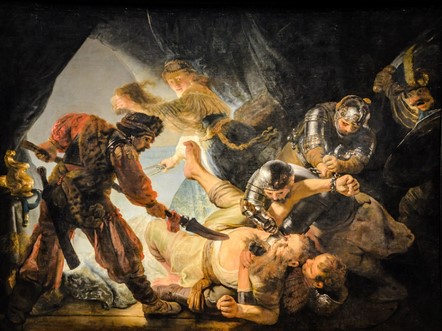
Rembrandt, The blinding of Samson (1636). Source: https://www.rembrandtpaintings.com/the-blinding-of-samson.jsp
This work of art shows us the hero’s suffering: spurting blood, gritted teeth, and the gouging of his right eye. Lovin Corinth actually has a version of Samson’s capture and blinding based on this painting. So, the following question arises: what is the main difference between these two pieces, and what makes The Blinded of Samson the most dramatic depiction of the character’s pain?
Firstly, Rembrandt’s version has many other characters in the scene. Corinth’s version, on the contrary, shows only the victim’s image. There’s practically nothing to distract the viewer from the tormented body. The settings details are practically nonexistent.
Secondly, the presence of Delilah is key. Rembrandt shows her holding a pair of scissors in one hand and a lock of Samson’s hair in the other. It’s worth noting that she has a special position in the scene (in the middle of the canvas and against the only source of light). This draws the viewer’s attention to the woman’s betrayal rather than to Samson’s agony.
Autobiographical hints and change of style
The painter’s wife, Charlotte Berend-Corinth, wrote about this painting suggesting it may have had autobiographical content. This makes sense coming from one of his closest people. Also, there’s a detail that may favor this hypothesis.
We can see a drop of blood about the hero’s chest near the heart. Could this have been intentionally put? Can this be a hint left by the author himself? There is a high probability that the answer is yes.
What we can positively ascertain is the dramatic change in Corinth’s style after the stroke. Even amateurs can see that Corinth’s art was influenced by this incident. Many experts relate this to his physical limitations and psychological distress, yet the artist manifested a clear interest in seeing form from a different perspective.
Conclusion
All in all, the Blinded Samson shows that not only do biblical texts influence art, but it also works the other way around. An author’s depiction of a particular scene can add a whole new dimension and even shift the interpretation of the story completely.
While other art geniuses poured Samson’s story into a canvas, like Rembrandt, Corinth has managed to give it a particular touch.
Probably based on his own experience, the artist of The Blinded Samson created a unique depiction of physical pain, psychological suffering, injustice, human cruelty, betrayal, and disappointment. All this is in a single human figure with almost no settings, which makes this work even more admirable.